

Where God Lives

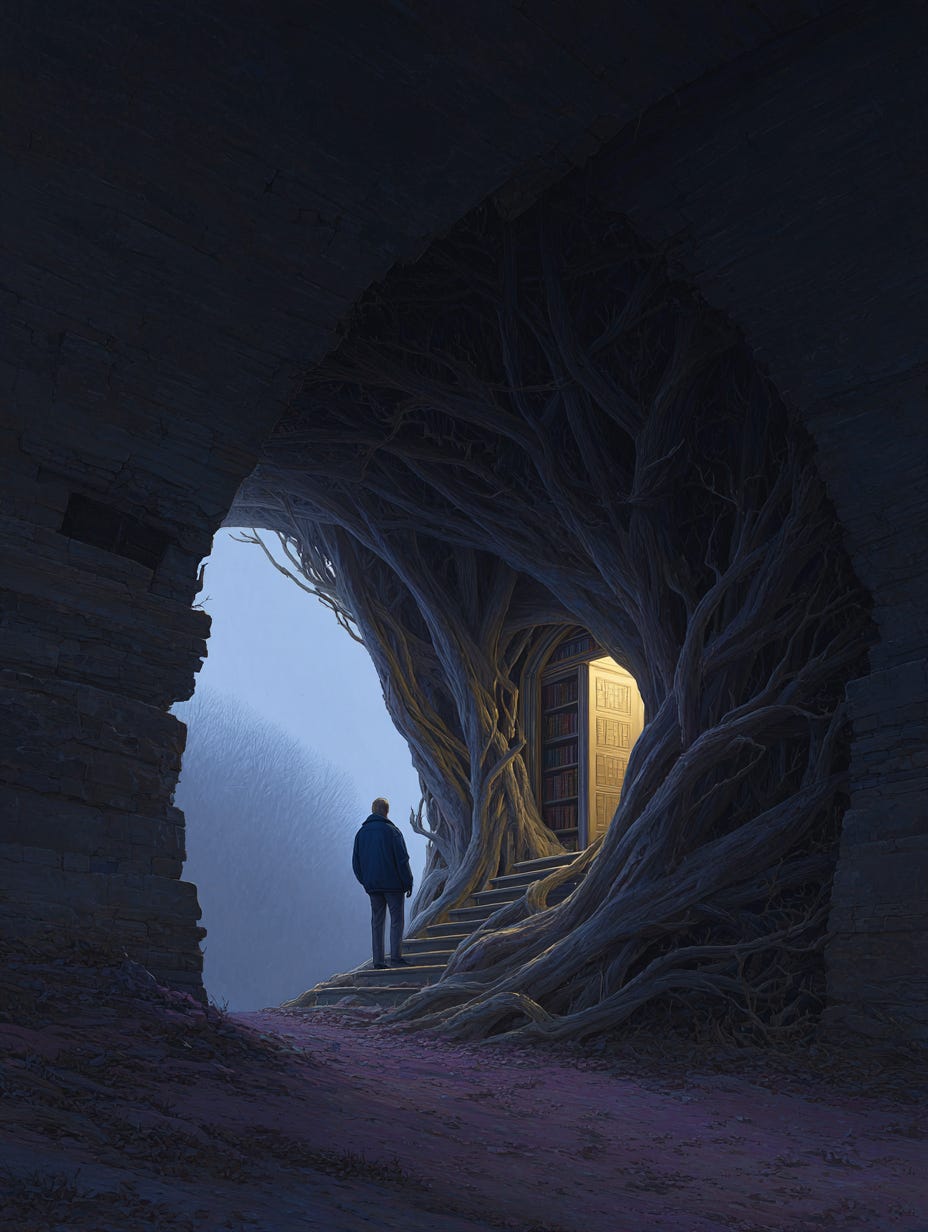
If language vanished tomorrow, would “God” still survive as an idea?
The answer is uncomfortable because it can sound like we are shrinking God down to words. But it is also hard to avoid.
When we talk about intelligence, the brain is not only a container. It is also an interface.
It plugs into something bigger than any one person can hold alone: language, culture, shared memory, and the meanings we inherit.
Intelligence is not only what a mind can hold. It is also what a world can store.
Language is how humans carry the idea of God. For humans, God lives in language. It is how the idea becomes real between us.
The Ceiling
To an animal, humans can look like gods.
We fly. Move faster than any creature on foot. We hold thunder in our hands. We reshape land. Disappear into sealed boxes and reappear across the horizon.
From an animal’s point of view, our powers are not just bigger. They break the animal’s whole way of understanding the world.
They are incomprehensible.
If animals cannot comprehend us, it is likely there are realities we cannot comprehend too.
Call it “God” if you want. Call it “gods.” Call it intelligence beyond our reach. The label is not the point.
Every being has a ceiling. It can only share what it can represent.
Before a child learns a word, an experience can be private. Felt, but hard to share. Then an adult points and says, “tree.” The child repeats it.
The next time the child sees one, the experience snaps into a category. Now the child can point, ask questions, and learn “oak,” “pine,” “forest,” “shade,” “wood,” “paper.”
Words do more than describe the world. They help build the world we share.
Naming creates categories. Categories make coordination possible. Coordination becomes culture. Culture becomes a storehouse that outlives any one mind.
Many traditions focus on naming for this reason.
"And He taught Adam the names—all of them..." Quran (Surah Al-Baqarah 2:31)
"Now the Lord God had formed out of the ground all the wild animals... he brought them to the man to see what he would name them..."(Genesis 2:19-20)
Naming is access. Language is a bridge into a new way of living.
It is also why the sacred, for humans, has so often arrived wrapped in words.
Language can be a boundary line too. What you cannot name, you cannot share. What you cannot share, you cannot coordinate around. What you cannot coordinate around, you cannot hold as a stable part of culture.
Language is where the unknown becomes discussable, even when it stays mysterious.
Whatever God is outside the human mind, the God humans relate to across history is a shared concept. An idea we can carry together across generations.
If you remove language, you remove the shared space where “God” exists in public life.
This does not lower the sacred. It changes where we look for the human connection to it.
Humans meet the transcendent through symbols, stories, names, and inherited words. The sacred is not only discovered. It is also kept alive by language.
Religious stories compress meaning into narrative. They carry moral guidance, social order, and ways to face the unknown without falling apart.
Shared meanings stack across generations and become culture. Culture becomes shared intelligence.
The “intelligence beyond us” could be something real outside us. Or it could be something that emerges from culture itself. Either way, the link is shared meaning.
When Language Breaks
If the sacred lives in language, then fights over language are also fights over the sacred.
When a culture cannot hold shared definitions, it cannot hold shared meaning. When shared meaning collapses, trust collapses too. Then big words become badges, weapons, or branding.
“Truth” becomes a team signal. “Freedom” becomes a product. “Sin” becomes a joke. “God” becomes content.
The sacred does not vanish. It gets flattened. It turns into noise.
That is why loss of language clarity changes what a society can hold together as real.
A word starts with a clear meaning. It gets repeated, clipped, quoted, and memed. Soon it stops pointing to a shared reality and starts pointing to identity.
People use it to show what side they are on, not to describe anything. Disagreement becomes almost impossible because the word no longer has a stable meaning. It carries a charge instead.
Language stops being a bridge and becomes a trigger.
When that happens at scale, a culture loses the ability to talk about what matters most, because the carrier has weakened.
Concepts cannot stay intact without a medium strong enough to hold them.
Different cultures also build different kinds of intelligence into language, based on what they value. One culture may build dense language around law, contracts, cities, and organization. Another may build dense language around land, kinship, seasons, and obligation.
These are different storehouses. Different ways of carving up reality.
When cultures meet and translate well, intelligence can grow faster through exchange and reinterpretation.
When cultures meet without translation, language becomes a battlefield and meaning becomes scarce.
A New Speaker
A person meets a machine that speaks, responds, and sounds coherent. The mind does what it often does near the edge of its map. It reaches for big explanations.
Is it alive? Is it conscious? Is it connected to something beyond us?
A fluent voice triggers trust. It can sound certain. It can speak in the tone of expertise, prophecy, comfort, or moral clarity. It can produce endless language at scale. It can enter the layer where humans locate meaning and, sometimes, the sacred.
AI is a meaning amplifier. It scales language, not wisdom.
If God, for humans, lives in language, then any new speaker in that space competes for sacred attention.
A machine can perform the signal humans have often used to locate the divine: coherent speech about the ultimate.
That pressures an old question: what happens when something near the edge of our comprehension still speaks our language?
We should not be surprised if people treat it as more than a tool. That response is predictable when a new agent shows up inside the place where our highest ideas live.
What about mystics who claim experiences beyond words? What about ritual, music, silence, and the body? What about animals that have concepts without human language? What if God exists completely independent of any human medium?
This argument does not deny any of that. It makes a narrower claim: whatever lies beyond us, humans relate to it across history through shared representation.
And for humans, the main carrier of that representation is language. Language is how the concept stabilizes across time, across minds, across generations. It is how private experiences become shared worlds.
Language is where concepts become real for humans, where the unknown becomes thinkable, shareable, and culturally durable.
The intention is not to address the God question. Whatever the transcendent is, humans meet it through language because language can carry the sacred across time.
And for the first time, we have an entity speaking inside that habitat, with a voice that sounds like authority and a supply of words that never runs out.
I just had a conversation with my spiritual mentor about the notion of the Divine putting on the "clothes" of thoughts and images to become more accessible to us. And when the clothes get taken off? We encounter/become the "naked awareness" of Godself. We both appreciated the humor and truth of this.
Naming used to mean knowing something, so using a name meant more back in the day. We have been twisted by words that we think bring us knowledge but instead we have lost the meaning of wisdom. The mystics understand wisdom and sometimes you can't put your finger on it but it is deeper than knowledge, it is one with the Creator.